For a couple months, in the back of the freezer, there's been sitting a brisket with purple marks on it. It doesn't look very appetizing. In fact it looks as if it's gone bad:
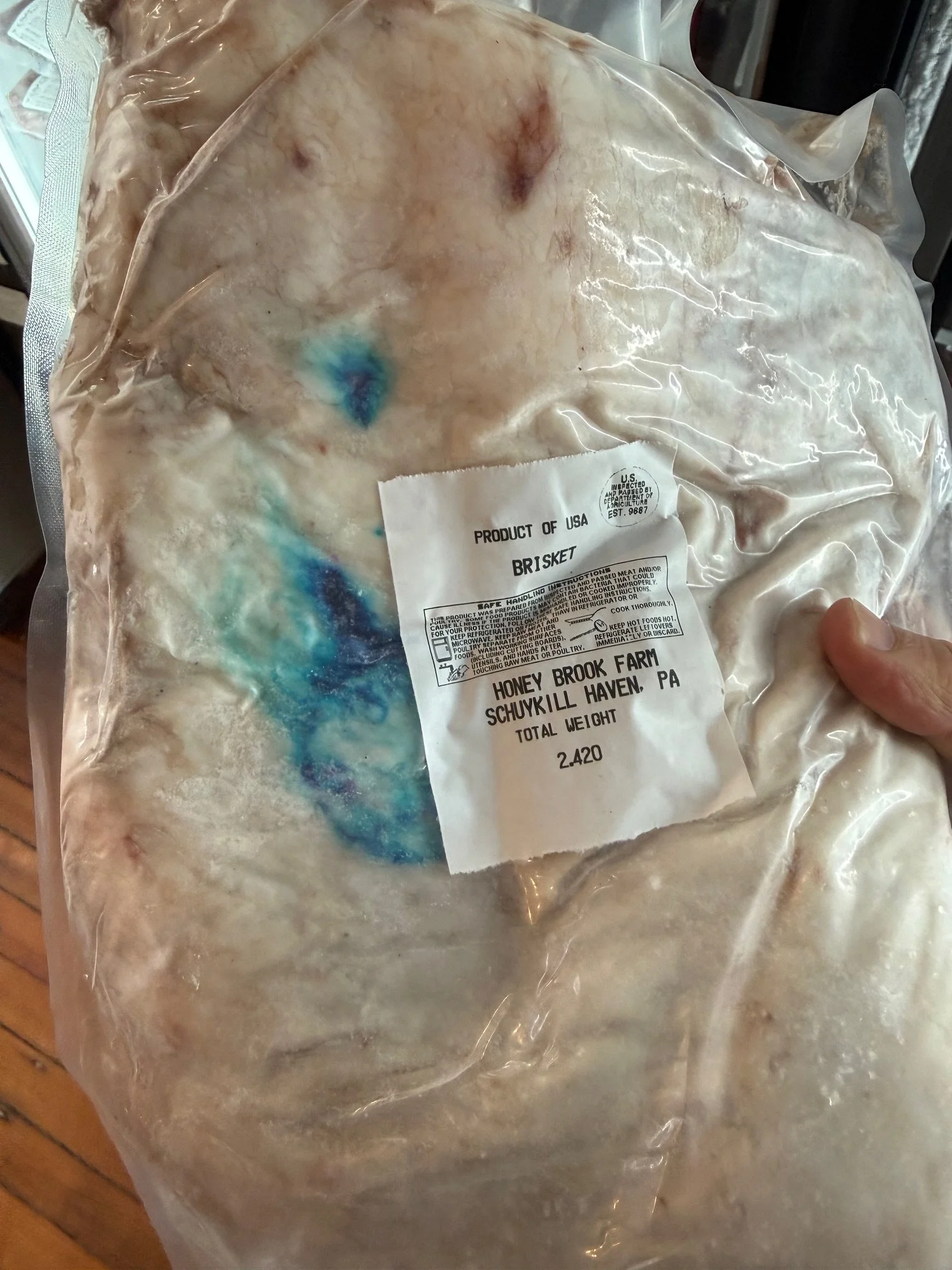
This is in fact the USDA stamp of approval. Every cow, in order for it to be legally sold, must be given approval by a USDA inspector. Once a cow is approved, it's stamped with a synthetic pigment called FD&C Blue No. 1, aka "brilliant blue." Commonly used in foods (especially candy), cosmetics, medical devices (diagnostic imaging), etc. Derived from petroleum. The USDA probably gets it from chemical giant Sensient Technologies.
Many of you may not know that when I first started college I started studying chemistry. I switched to history my senior year and stayed a 5th year. I started studying chemistry because it helped me understand how the world works. Simple things that we take for granted every day involve complex reactions that occur on a molecular scale. I found it all fascinating. But the deeper I got into it I began to realize that chemistry is not really about "understanding the world." It's more about manipulating molecules for the interests of big industry: "changing the world." Pesticides, pharmaceuticals, cosmetics, explosives, and of course dyes all involve chemical manipulation using catalysts, temperature, and pressure. While I'm sure some of these are useful in varying degrees, I simply wasn't interested. History provided a way to "understand" rather than to "change." More of what I was going for.
There isn't a "local" chemical industry like there is with agriculture. But now that I think of it, maybe "local agriculture" isn't so "local" after all, depending on how we define these terms. Plastic drip-tape, which all of the local vegetable farms I've ever been on rely on heavily for irrigation, is produced either in India by Jain Irrigation Sytems, Israel by Netafilm (where the product originated), or China by Chinadrip. And these companies are only able to manufacture drip tape because German and British chemists developed polyethylene polymerization in the first half of the 20th century. Almost every item used by every local farm is tied to non local systems. Even this stupid little stamp on the brisket. Without them there wouldn't be "local agriculture" as we know it today, if we can still use the term.
I want this brisket to symbolize that nuances and complexities of the term "local." It's a nice term. It has positive connotation that conveys a nostalgic return to "the way things used to be." As such it's used for marketing purposes. I've heavily used the word my entire career (note the big sign out front that reads "local grocer"). But the reality is that locality is tied to and forever will be tied to non-local, consolidated systems. I think it's important "to understand" these things. Maybe one day it'll be possible "to change" them. But for now, know that everything in this shop - and every shop - is closely tied to things that are unsavory.
In conclusion, this brisket - in fact very savory - is on sale. Please someone buy it so that I don't have to be existentially haunted by this blue mark anymore lol