Non-local brisket

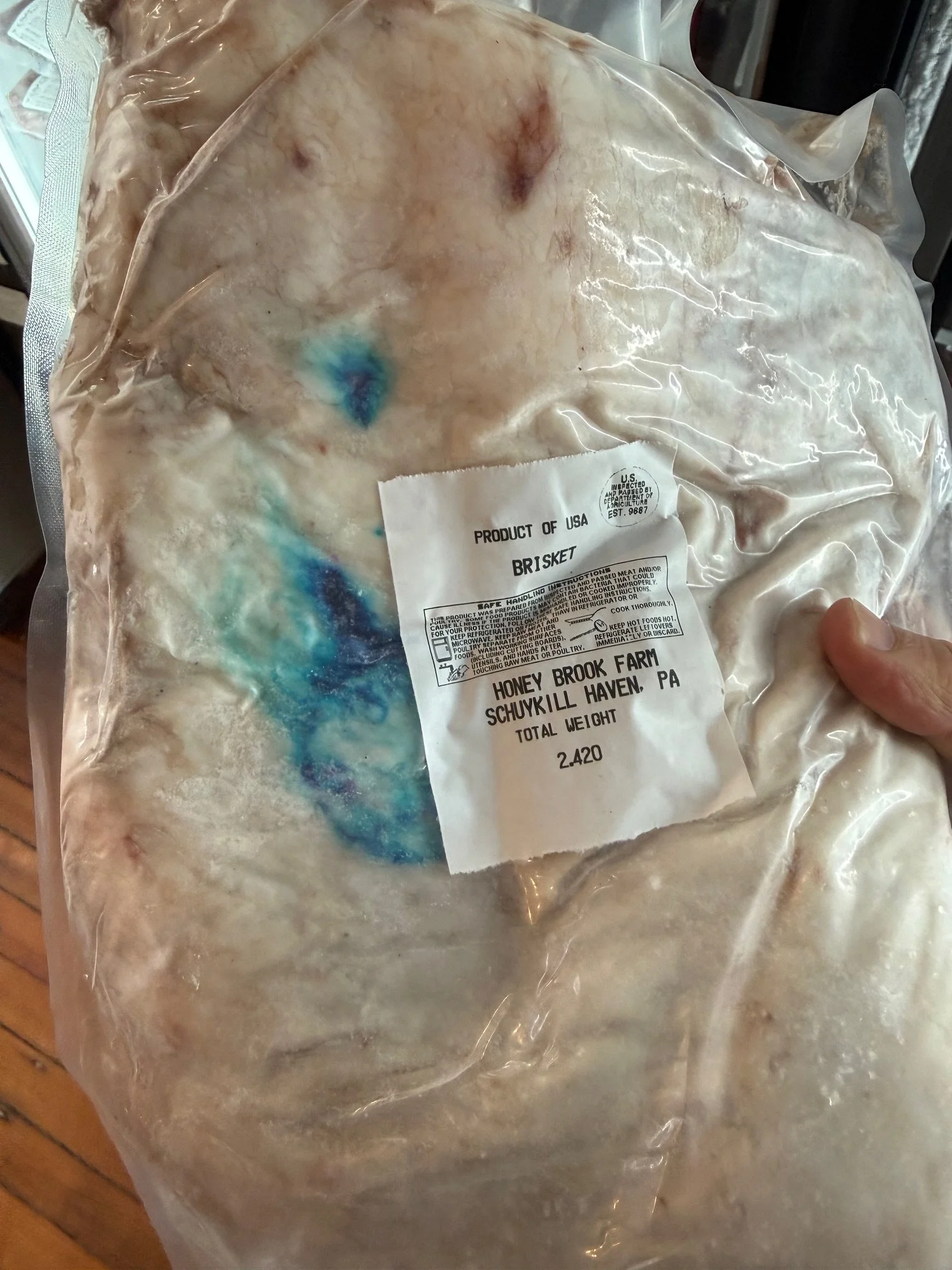
For a couple months, in the back of the freezer, there's been sitting a brisket with purple marks on it. It doesn't look very appetizing. In fact it looks as if it's gone bad:

This is in fact the USDA stamp of approval. Every cow, in order for it to be legally sold, must be given approval by a USDA inspector. Once a cow is approved, it's stamped with a synthetic pigment called FD&C Blue No. 1, aka "brilliant blue." Commonly used in foods (especially candy), cosmetics, medical devices (diagnostic imaging), etc. Derived from petroleum. The USDA probably gets it from chemical giant Sensient Technologies

Many of you may not know that when I first started college I started studying chemistry. I switched to history my senior year and stayed a 5th year. I started studying chemistry because it helped me understand how the world works. Simple things that we take for granted every day involve complex reactions that occur on a molecular scale. I found it all fascinating. But the deeper I got into it I began to realize that chemistry is not really about "understanding the world." It's more about manipulating molecules for the interests of big industry: "changing the world." Pesticides, pharmaceuticals, cosmetics, explosives, and of course dyes all involve chemical manipulation using catalysts, temperature, and pressure. While I'm sure some of these are useful in varying degrees, I simply wasn't interested. History provided a way to "understand" rather than to "change." More of what I was going for. 

There isn't a "local" chemical industry like there is with agriculture. But now that I think of it, maybe "local agriculture" isn't so "local" after all, depending on how we define these terms. Plastic drip-tape, which all of the local vegetable farms I've ever been on rely on heavily for irrigation, is produced either in India by Jain Irrigation Sytems, Israel by Netafilm (where the product originated), or China by Chinadrip. And these companies are only able to manufacture drip tape because German and British chemists developed polyethylene polymerization in the first half of the 20th century. Almost every item used by every local farm is tied to non local systems. Even this stupid little stamp on the brisket. Without them there wouldn't be "local agriculture" as we know it today, if we can still use the term.

I want this brisket to symbolize that nuances and complexities of the term "local." It's a nice term. It has positive connotation that conveys a nostalgic return to "the way things used to be." As such it's used for marketing purposes. I've heavily used the word my entire career (note the big sign out front that reads "local grocer"). But the reality is that locality is tied to and forever will be tied to non-local, consolidated systems. I think it's important "to understand" these things. Maybe one day it'll be possible "to change" them. But for now, know that everything in this shop - and every shop  - is closely tied to things that are unsavory.

In conclusion, this brisket - in fact very savory - is on sale. Please someone buy it so that I don't have to be existentially haunted by this blue mark anymore lol

Iran, California, and pistachio geopolitics

I don't know if this is my imagination, but in the past year it seems to me that pistachios are popping up everywhere: Starbucks has a pistachio latte apparently? Everyone's talking about Dubai chocolate, which is filled with pistachio cream? There are even pistachio-based beauty products?? It's weird. And suspicious..

But if we zoom out this isn't something unusual: agricultural trends happen all the time. And they all have something behind them. The avocado-toast craze was heavily promoted by the Hass Avocado Board. The almond milk craze? Yup, marketed by the Almond Board of California. The largest growers in the country fund their operations. These are powerful. Lots of money. Lots of political influence. 

The new pistachio-in-everything craze is the same story. The American Pistachio Board is largely responsible for it. They work actively to promote pistachios as an ingredient for coffee, ice cream, baked goods, etc. They even run marketing campaigns in China, India, the EU, and the Middle East for export.

There's nothing inherently wrong with this. It's not a bad thing that farmers have groups to represent them to help sell their products. Buuuut if we look a little deeper, we begin to see some other stuff. 

The biggest funder of the American Pistachio Board is The Wonderful Company, the parent company of Wonderful Pistachios, the largest pistachio farm in the US: 65,000 acres of nothin' but pistachios. Available at your nearest Costco! It's owned by the billionaire Resnick family, the same owners of Fiji Water and POM pomegranate juice. They grow 20% of America's pistachios, the vast majority of which come from about 5 total farms. Together they dominate global pistachio production: 55% of the world's pistachios come from a small handful of American farms today.

Pistachios are not native to California, where about 98% of American pistachios are grown. They are native to Iran. Iran was dominant in the global pistachio trade for most of the 20th century up until the early 2000s. It was their second most important export after oil and gas. A major cash crop for the country. They grew half of the world's pistachios by the early 2000s, and the US only produced around 12% at the time. Now, Iran only produces around 20%. So what happened in the span of a decade or two?

In the 1980s the then American Pistachio Commission, which later became the American Pistachio Board mentioned above, lobbied the US government to impose an anti-dumping tariff on Iranian pistachios: Raegan's Commerce Department determined the Iran sold pistachios to the US far below fair market value, so the administration imposed a 241% tariff (odd-number, I know) in 1986 on Iranian pistachios. 

The timing was perfect. Pistachios take years to produce, and California farmers had planted a lot of pistachio trees in the 1970s. The trees were beginning to produce. California farmers gradually bought more and more land, planted more and more trees. Hedge funds aided in the expansion and still invest in pistachio orchards, benefitting pension funds. Wonderful Pistachios, in order to keep their trees hydrated, even bought the state owned Kern Water Bank during California's water privatization deals in the 1990s. All of this secured the rise of American pistachio production and the decline of Iranian dominance. 

Iran simply could not compete globally with the efficiencies that come with American agricultural concentration. While the US has less than a thousand farms each producing a lot, Iran has tens of thousands of farms each producing a little. There are structural inefficiencies that come with this. The largest pistachio farms in the US are vertically integrated: they own the farm, the processing center, and the distribution networks. In Iran, each farm is too small to have such infrastructure, so each farmer has to sell the raw product to a processor, who sells it to a packager, who sells it to an exporter. The US, due to this centralization, can export to China and other countries at a much more consistent, uniform quality than can Iran. Just as in the local supermarket where all the fruit and veggies look the same, uniformity is what is sought out in the global trade of pistachios. Even though Iranian pistachios are cheaper and more delicious, uniformity is preferred.  

This type of agriculture, while it's efficient and effective on a global scale, over time results in environmental degradation and wealth concentration (this isn't to say that Iran doesn't have huge farms that are tied to power: one of them is owned by Akbar Hashemi Rafsanjani, the former billionaire president of Iran). This is the way things are. While the second law of thermodynamics states that systems become more disordered over time, it seems as if the first law of global trade states that industries become more ordered and structured over time.

My hope is that this law isn't written in stone. I've been talking to some small, organic pistachio farmers out West. So far I haven't found one I like. If I find one, I'll let you know.

Lent, Tofu, and the Mississippi River

There are a few items in the store that I order for myself. They come in large cases, so I take home what I need and put the rest on the shelf in case anyone else is interested. This week I ordered tofu. Not because I particularly like tofu, but because I’ve given up meat for Lent. For the next six weeks I’ll need alternative sources of protein. If I appear miserable, that's why.

For a variety of reasons I’ve written about in the past, I believe pasture-based meat farming is one of the best ways to produce food. So — naturally — I had to give it up. Maybe it'll build some character. 

Giving up meat has got me thinking about how meat is produced on a global scale. When I was in graduate school I had a few classes about the impact of geography on world history. Geography is not something we think about very often, nor is it deterministic, but it's pretty important. We act within the confines of land mass, climate, and riverways. Perhaps meat production would not be so global had America's geography been different.

The Mississippi river has had a big impact. When you combine it with the Missouri and the Ohio rivers, which both flow into it, it forms the longest, navigable waterway in the world. Something like 15,000 miles. And they all flow through land mass that is ideal for corn and soy farming. Because transportation is far less expensive by water than it is by rail, and because public policy since the 1970s favors large scale grain production, the United States has become the top producer of corn in the world. By far. And second in the world in soy production. 

The grain is packed onto ships, taken down the Mississippi to ports in the Gulf, and from there shipped all over the world where it is processed into animal feed: Mexico, Japan, China, Argentina, the EU, etc. More than half of the world's meat production is dependent on the global trade of corn and soy.

And that's not even mentioning all of the other industries: ethanol, sweeteners, cooking oils, bioplastics, industrial chemicals, soap, lubricants, ink, pharmaceuticals, etc.. Trillions of dollars of global GDP derive from the corn and soy shipped along the Mississippi River and other waterways around the world.

Lent just had to remind me about all this didn't it. I'm always overwhelmed by the scale of "big." It seems overly complex when all cows need is some simple grass (not to downplay pasture management, which is in fact really complicated). Maybe it's even somewhat soulless. But at the same time it's also marvelous. The engineering feats, the technological triumphs, and the scientific advancements that led to all this are without a doubt incredible. But of course it has plenty of downsides that I won't bother getting into. 

I've chosen to dedicate my life to promoting the "small." For me, eating locally and seasonally, eating local pasture raised meat, is not only about the better taste or nutrient makeup. It's also about supporting an economic system that I believe is simply better. I just had to give up a very satiating component of it for a while to help me appreciate it more. Hopefully the next few weeks pass by quickly. 

The special bread Saturday is the dense and very satiating German style black bread. I might just have to keep them all for myself, though 😂.

Monsters at Target

Yesterday I was driving around town, passed a CVS, and remembered that my dentist for years has been yelling at me to get a mouth guard to protect my teeth from nighttime grinding. I pulled into the parking lot to realize that this CVS happened to be inside a Target. Now I think that this was the second time in my life that I've been inside a Target. As soon as I entered I was struck by how large the store is. How can I ever find such a small item inside such a large store, I thought? After pacing back and forth frantically looking for what at this point I believed to be a made up CVS, I eventually gave up and left. What's another night of bruxism? Just don't tell my dentist. 

I've worked at and visited farms of all different sizes. And I must say that the ones at which I've felt the most comfortable have been the ones at which I am able to see the entire field while standing at the center and turning 360 degrees. How else would I know whether or not there is a monster lurking at one of the corners? But in all seriousness, a smaller farm allows the farmer to more easily spot an irrigation leak. Or beds that are overtaken by weeds, disease, and pests. Or how ready a crop is for harvest. Just by standing at the center and turning around. 

There might be a bit of a God complex involved with all this. Here I am, the creator of this tiny corner of the world, peering over with adoration and pride in my hard work. Perhaps doing this all from a single point makes me feel all the more powerful. "All is vanity," as the author of Ecclesiastes wrote.

Aside from the vanity under the surface, I have found that, much like Occom's razor, whereby the simplest answer is usually the correct one, the smallest business is usually the best one. Now this is of course a value statement, and everyone has different values by which they determine something to be "the best." But allow me to give you just one concrete example out of many so that you can have an idea of the values that tend to be important to me.

That is sourcing transparency. Target has sourcing statements on their website. I'm sure there is sincerity to it. But the problem is that I just don't know for sure. There simply is no way for me to verify anything. I can't just call Brian Cornell, the CEO, ask him specifically where in the world a particular item of clothing is made, fly out to witness the manufacturing process, ask the plant owner where they got the materials to make said clothing, and fly out to wherever in the world that is grown to learn about the agricultural practices. I suppose there are journalists in the world who do this sort of thing, but it's probably beyond the capability of most people, including myself. I'd just rather give up, walk out of the store, and grind my teeth while worrying about a potential monster hiding in a far off shelf that I can't see. Yea...dark...I know.

It's all different at a small shop. I can call up the CEO (hint you all have my personal number); I can ask where things are made (hint hint list below); and I can take a short drive to learn about the manufacturing process (hint hint hint we can even go together).

I hope I'm not tooting my own horn here. This is all completely objective, right? Maybe not. All is vanity, after all.

Less is More

I want to talk a little about a book that gave me the confidence to start my own farm: The Market Gardener: A Successful Grower's Handbook for Small-Scale Organic Farming by Jean-Martin Fortier. Fortier is often referred to as a "Rockstar farmer." He is hugely popular - every organic farmer knows his name (JM is his nickname) - and he has inspired an entire generation of young organic vegetable farmers by building upon and popularizing a very simple idea.  

Before JM's book most prospective farmers believed that starting their own farm was not doable: finding 10+ acres of land, purchasing a tractor and tractor attachments, etc are financial burdens that few can overcome. But according to JM the solution is simple: do away with the tractor.

Most vegetable farmers plant crops on a designated bed . A typical bed is around 30-48 inches wide and around 100-200 feet long depending on the landscape. And there are walking paths between each bed. The problem with a tractor is that the spacing between beds is defined by the distance between the tractor wheels: the tractor wheels must go onto the walking paths so they do not disturb the planting beds. Well, that's a lot of wasted space. If there's no tractor you could space planting beds much closer to one another, just wide enough for two feet to walk on. 

Another problem with tractors is that they are typically used to "cultivate." Cultivation means to kill weeds by lightly scratching the surface of the soil with tines that are attached to the tractor. The distance between the crops in the bed are therefore defined by the distance between the tines on the tractor attachment so that the tines don't actually kill the crops: they just pass over them because the farmer plants the crops at the appropriate spacing. But this is also wasted space because plants actually grow just fine at much denser spacing. And guess what: when plants are close together they form a canopy that blocks out sunlight to competing weeds. This canopy also keeps in moisture, so you don't have to irrigate as much. 

So without a tractor you can space your beds closer together. You can also plant the crops within the bed closer together. This means that without a tractor you only need a small fraction of the acreage to grow the same amount of produce as you would with a tractor. Compare the two pictures below and I think that the advantages of not using a tractor become quite clear.

With a tractor:


Without a tractor:


JM has a very high yielding and successful farm on just 1.5 acres. Others have built upon his ideas and have developed successful strategies on even less land. You don't need a lot of land to grow a lot of food. 

Although I'm not farming anymore I still use this principle at the shop. It seems as if there isn't much variety compared to large supermarkets due to the small size. But that small 3-door freezer has more cuts of meat than a thousand square feet in any large grocery store. The picture below really only has a handful of items sprawled out over a lot of wasted space. It's the grocery store equivalent of a tractor-based farm. Indeed the meat is displayed nicely and well organized while my 3-door freezer is a mess, but really all that's on display here is the illusion of variety. 

(imagine a pictures of a standard grocery store meat shelf haha)

I Hate Strawberries

How could anyone hate strawberries, you might ask? I have an explanation for you. But first, yes, I'm going to have strawberries on Wednesday at 10:30. And from the looks of it it's going to be the best strawberry season in recent memory. It's been a rather dry spring, and strawberries, like us, do not appreciate too much rain. Something they do appreciate, however, is high levels of nitrogen. When the soil has enough nitrogen, strawberry plants are high yielding, resistant to disease, and are particularly delicious. The farmer I'm getting these strawberries from, Dylan from Clean Green Growers in Sellersville, is well aware of this, so he had his chickens run around the strawberry field all last summer before planting in the fall. This was very smart. Chicken manure is high in nitrogen. Now he (and we) are reaping the benefits. They're some of the best strawberries I've had: big, sweet, juicy, red all the way through. Certified organic of course (note that conventional strawberries are very heavily sprayed with lots of bad stuff). They'll be picked early Wednesday morning and brought over by 10:30. I'll probably get more fresh on Friday. Come as soon as you can. 

Now, why do "I hate strawberries"? Well it's something similar to why the chocolate ice cream from Owowcow is called "I hate chocolate." When they first started they mixed their ice cream by hand, and when they added the chocolate it became very rich and difficult to mix. Everyone said they "hated chocolate" and so the name stuck. Strawberries are tough to harvest. They are low lying plants. The farmhands have to move quickly because there is so much of it, and 20 minutes after you take several hours worth of picking down to the roadside stand, they're sold out. So you have to pick more. The month of June at every farm I've worked at is nothing but picking strawberries for like 10 hours a day. 

But that's not the real reason why strawberries are universally hated by farmhands. Picking strawberries, while it makes your back sore, is still sort of fun. I recall having strawberry food fights while picking. I recall rewarding myself with eating one strawberry for every quart I picked. I recall gently pushing fellow farmhands off their well balanced squats so that I'd get the upper hand in the strawberry picking race. And the weather is still beautiful and comfortable. The days are long, so bathing in the not-so-intense sun makes everyone happy. While it's hard, it's a good type of hard. I kinda miss it.

But the long days present a problem. Plants grow quickly when there is a lot of sun. That includes weeds. Weeds are easy to deal with when they're small. All it takes is some minimal soil disturbance with a hoe. But everyone is busy picking strawberries to deal with the weeds in that far off field of carrots, or potatoes, or cabbage, or beets, or peas. So the weeds grow tall to the point that the only solution is to get on your knees and hand pull. In July, no less, when it's hot. Some farmers have a better handle on weeds than others. I've experienced both types of farms. But when they don't you can bet that you'd hear farmhands in July comically muttering to themselves, "I hate strawberries" or "stupid strawberries." Weeds just aren't as fun to throw at one another as strawberries are. 

You know after writing this I'm having the thought to tell this story to the folks at Owowcow to suggest that they make a chocolate strawberry ice cream. Though maybe that's too much hatred in a single container? haha 

Acme and Costco

Once every few months I go into other grocery stores just to check prices. I went to Acme and Costco (I'm only a Costco member because of their cat food and my vet advised against feeding them local, organic chicken. Are vets bought out by big ag? Perhaps a topic for another newsletter). I'm always surprised at what I see at these stores. The prices of non-local, conventional food are in many instances close to, the same, or higher than local, organic food, and below you'll see some pictures. I didn't bother going to Whole Foods, but I'm sure it's the same story. 

Inflation has a lot to do with this. While conventional food prices have gone up, the prices at my shop have not. Inflation does not affect a local food economy in any significant way. I wrote a detailed newsletter about this phenomena a while ago, but the main reason why this is the case is the fact that conventional food revolves around a multileveled supply chain: farmers, auction houses, butchers, packers, distributers, wholesalers, and finally retailers. A price hike somewhere along the line compounds down the supply chain, especially when the price of oil inflates. With local food, it's simple: farmer then retailer. That's it. And the food is traveling a much shorter distance, so an increase in travel and refrigeration costs tied to oil are negligible. 

But inflation is not the whole story. Every different type of food has it's own unique set of circumstances, but I want to explain beef because, well, I like beef.

It's partially true to say that Covid and inflation is the culprit for the rise in price of conventional beef. The pandemic shut down some of the largest meat packing facilities in the country. Ranchers thus had no place to send their beef. So supply dwindled. As a result ranchers reduced their herd size. Since it takes time to increase herd size, if that's what a rancher decides to do, conventional beef prices have remained high. But ranchers don't want to increase their herd size again. Rising prices for oil, supplies, and feed have have made the cost of business too high. As one rancher from the Nebraska has said, "we're spending $1 million to make $4,000." 

But this is too simplistic an explanation. I want to focus on the feed. It's the largest expense for any ranch and feedlot. Conventional cows spend most of their lives on a ranch out on pasture eating grass. The rancher then sells the cows at an auction house to a feedlot where they are fattened up on corn/soy feed for a few months before slaughter. But over the course of the last several years there have been droughts in the Midwest and in Texas. When it doesn't rain, the grass doesn't grow. Corn/soy also doesn't yield as well, and nor do hay and alfalfa. So the ranchers, not having sufficient grass on their pastures, had to buy in alfalfa and hay, which was already inflated in price due to the droughts. And after they sold the cows at auction to the feedlot, the feedlot fed them inflated corn/soy. Multiple compounded price hikes.

That's more complex of an explanation. But we're still not at the main culprit. It's this: conventional farming practices. The pastures on most ranches are overgrazed. Ranchers have been pushing the limits of their pastures for nearly 100 years. Too many cows for far too little land. If the pastures are overgrazed and have little time to recover, they are less resilient when drought hits. The grass also has less nutrition during a drought, so the cows need to eat more of it, compounding the problem. And the very fact that the cows are fed corn/soy is the next main problem, since the fields of corn/soy are also suspectable to drought for similar reasons: most corn/soy farmers don't add compost and don't cover crop, which would increase the water holding capacity of the soil (one pound of compost added to every 100 pounds of soil increases water holding capacity by 4 gallons...that means no drought. It's so simple it's almost comical). 

The main culprits of the increase in conventional beef prices are these: overgrazing and corn/soy feed. Any other explanation falls short. It's why right now at Acme ground beef costs $8/lb ($9/lb at Dave's), filet mignon costs $48/lb ($40/lb at Dave's), and NY Strips cost $25.59/lb ($25/lb at Dave's). It's why at Costco short ribs cost $13/lb ($12/lb at Dave's) and rib eyes cost $25/lb (same at Dave's).

Though the main thing that I encourage you to takeaway here is the fact that overgrazing and corn/soy feed artificially lower the price of beef to begin with. That's not even mentioning corn/soy subsidies. 

That's the story with beef. Every one of the products pictured below has its own story. I'll share them another day.


"Pastured" eggs at Acme $8.49 vs Real pastured eggs for $7 at Dave's

Short ribs at Costco for $13/lb vs $12/lb at Dave's

Chicken wings at Acme $4.49/lb vs $5/lb at Dave's

Chicken thigh at Costco $6/lb vs same at Dave's

Yogurt at Acme $5.19 vs $6 at Dave's

Honeycrisp apples at Acme $3.99/lb at Acme vs $3/lb at Dave's

Cheddars for $9 at Acme vs $7 at Dave's

Turkey bacon for $8 at Acme vs same at Dave's


Ground beef $8/lb vs $9/lb at Dave's

Feta $18.64 at Acme vs $18/lb at Dave's

Duck eggs $4.79 at Acme (with a messed up label no less come on Acme) vs $5 at Dave's

Bacon $15.38/Lb vs $14/lb at daves

Chicken breast $9/lb at Acme vs $10/lb at Dave's

How pigs helped us win WW2

Mangalitsa is a fattier type of pig. Originally from Hungary and Romania. It was historically bred for lard, which was the most popular cooking fat for quite a long time. Lard was also used for making soap, candles, cosmetics, industrial lubricants, even explosives. During WW2 the government's American Fat Salvage Committee urged Americans to donate to the army their used up cooking fat, which was mostly lard. Just one characteristic of what historians have called "Total War," where the entire population, including civilians, is mobilized in some way for the war effort. It's a relatively modern form of warfare. The Napoleonic Wars were probably the first. Weird side track. Sorry. I just like history, especially when food comes into play.


Anyway..

Some time in the second half of the 1900s saturated fats lost popularity. Vegetable oils began to dominate the industry. It changed the physical landscape of America. Corn and soy fields replaced heritage pork varieties because no one wanted lard anymore. That came with a whole host of unforeseen consequences. The Yokshire pig, the cute pink one, began to dominate the pork industry because it's very lean, has mostly polyunsaturated fat (the same fat in veg oil), and grows quickly. Hundreds of old breeds were lost as a result. 

Most old breeds, like the Berkshire breed, are higher in saturated and mono-unsaturated fats (The same fat that's predominant in olive oil).  But, this pig, the Mangalitsa pig, is somewhat unique. It's very high in monounsaturated fats, something like 60% (olive oil is around 75%). It also has 2-3 times as much Omega-3s as many fish breeds. The result is a very healthy pork with fantastic flavor. 

It's coming from Stone Arch Farms in Litiz, PA. They're pastured. Eating forage and non-gmo feed. All the good stuff. It's not much more expensive compared to the other pork I carry. Quite a value for the quality in fact.

My trip to Armenia

Shortly after arriving in Yerevan the taxi I took to get to my friend Garine's apartment broke down. Right in the middle of one of the busiest roads in Yerevan. After the driver, Zorab, tried to restart it to no avail, he put it on neutral and asked me to jump out and push while he tried to reignite the engine. After a couple minutes of doing this the engine started and he yelled for me to jump back in while it was in drive. The remainder of the ride involved Zorab repeatedly apologizing, inviting me to his house for cognac (100 years ago Armenia won some big brandy contest in France and was granted the privilege of calling its brandy "cognac"), and refusing to take any money. I told Garine this story when I finally arrived at her place. Welcome to Armenia, she replied. 

Over time I realized how much this small episode encapsulates much of Armenia. Well, Eastern Armenia.

Armenians for over a thousand years were split between the rule of the Byzantines/Seljuks/Ottomans in the West and Persia/Imperial Russia/Soviet Union (now modern-day Armenia) in the East. Before the emergence of these great powers Armenia was comprised of a number of different kingdoms, on and off, in different locations, under the rule of different Armenian speaking dynasties for the previous two thousand years. The remnants of Armenian history and culture remain scattered across the region: from modern-day Turkey in the West to Azerbaijan in the East; from Georgia in the north to Israel in the South. Mostly churches and monasteries, some in ruins, some still functioning. 

One of these remnants is the medieval city of Ani, located in Eastern Turkey along the border with Armenia. A silk road city, Ani was one of the largest cities in the world in its time, from the 10th-13th centuries. Growing up I heard the songs and poems about Ani. These songs are constructs of modern-day romantic nationalism. One of them is entitled "Let me see Ani and die." They constitute the great deal of national pride that Armenians feel towards this city. While I tend to intellectually run away from nationalism in any form, ironically on an emotional level it's an inescapable part of me. Let's just say that I saw Ani, but I'm not ready to die. 


A week before I arrived in Turkey Ogün Samast, the man who assassinated Hrant Drink in 2007, was released early from prison because of "good behavior." Drink was a Turkish-Armenian journalist who was critical of the Turkish government's denial of the Armenian Genocide. This angered nationalist Turks, many of whom conspired to kill him with the knowledge and assistance of police intelligence and security forces. It was a huge scandal. After his death his family started the Hrant Drink Foundation in order to build relationships between Turkey and Armenia, to monitor hate speech, and to improve human rights in Turkey.

There are many Armenians who live in Turkey today. But most of them are not as vocal as Dink. It is hard to be vocal when the main street going through the Armenian neighborhood is "Talat Pasha Street." (Talat was the architect of the Armenian Genocide). These people are known as the "Hidden Armenians." They are descendants of Ottoman Armenians who were forcibly Islamized under the threat of extermination during the genocide. Over the years many of them maintained their identity and their faith but in secret. Others have lived their entire lives thinking that they were Turkish only to discover later in life their Armenian roots. My friend Garine who welcomed me in Armenia is in fact a Turkish-Armenian. She discovered her Armenian heritage when she was a teenager and proceeded to take Armenian language classes through the Hrant Dink Foundation. It changed her life. She travels back and forth between Istanbul and Yerevan, learning about her heritage and solidifying her identity in the process. 

While the genocide was the most profound event that had devastating consequences for modern Western Armenians, the fall of the Soviet Union was probably the most consequential event for modern Eastern Armenians. Overnight in 1991 the underlying wretchedness of the Soviet system that had been easy to miss by unsuspecting eyes emerged out into the open. Entire industries were cut off and abandoned. The mafia and high up communist party members divided up the remaining industries and took political power, creating the modern-day Armenian oligarchy. While a recent revolution is slowly improving things, when one exits the more or less cosmopolitan city center one sees that the urban landscape of Yerevan today remains a strange combination of abandoned Soviet buildings and of the gilded opulence of the oligarchs' hotels, department stores, casinos, and strip clubs. 

Here is a hotel owned by the oligarch Gagik Tsarukyan. 


And here are some abandoned Soviet structures. Some of these places have guards, some don't. For those with guards, some of them will let you take a better look, some will with bribes, and some will scream at you.


This is the Orgov Radio-optical telescope on Aragats mountain. Abandoned. Further up the mountain is an abandoned top-secret Soviet weapons facility. Not easily accessible.  


Stealing Soviet state secrets


Within this landscape are the everyday people of Armenia. Many quite wealthy and successful. Many impoverished. Many working for little pay. Many refusing to work for so little. Many, over 100,000, forcibly removed by Azerbaijan from the disputed region of Nargono-Karabakh into Armenia proper just a couple months prior to my trip, having lost everything, including family members--all doing the best they can with what's been given to them within this small country. 

There is one common denominator among all of these people, regardless if they have a lot or a little: it's their warm hospitality, generosity, and kindness. It's all too easy for a random interaction on the street or in a taxi to result in an invitation to one's house for a meal. One woman we met invited us multiple times for dinner and even for making sujuk, which is quite the process. You take a needle and thread and put it through walnuts (from your own walnut tree of course), dip this strand of walnuts into a thickened mixture of grape fruit juice (from your own grapes), flour, and water, and hang to dry. 


Much of Armenian culture and cuisine revolves around fruit. Everyone has their own fruit trees. They dry them, make Armenian style fruit roll-ups, sujuk, and even spirits. Everyone has a cellar that's full of spirits made from 5 different fruits. They all taste completely different, and people are more than happy to share.


When I visited my mom's old house, the family who lived there warmly welcomed me and got the entire block together to make kebab. Not without homemade spirits. Lots of them. I don't remember much from that day. Apparently I called my mom while it was 5am here to show her her house on Facetime...followed by a call to my Aunt in California, 2am.

After my time in Armenia I took a plane back to Istanbul and stayed there for a couple more days before heading home. I reflected a lot on my stay in Armenia while exploring Istanbul. When I lived in Turkey 13 years ago I had had the intention of visiting Armenia at that time. It didn't happen then for a variety of reasons. So this trip was a completion of that initial intention.

Due to all the stories, songs, and culture I grew up around, for much of my life I've had romantic notions of moving to Armenia (a few of my childhood friends have done that). It's been an itch in my side for a long time. I am relieved and happy to say that this trip has dispelled these notions and helped me realize that they were mostly based upon fantasy. It was a challenging trip for some of the reasons I mentioned above and a lot more that I didn't mention, but one that was necessary and illuminating. I thank you all, and special thanks to Johnny, Bella, and my father who kept things running in my absence, for making it all possible. 

Convict labor

I want to write a bit about potatoes today. The potatoes that are currently at the shop were harvested in Lancaster County in July and cured for a few weeks. They sat in a storage barn since then at a nice temperature of 50 degrees and awaited my order, which I placed a couple weeks ago. Over the course of these several months between harvest and my order the potatoes became somewhat dehydrated and thus wrinkly and sad looking. Some of them are even starting to grow a bit. I occasionally knock off the shoots. After they are harvested and cured, potatoes go into dormancy. This dormancy begins to break after some time. So they start growing again.

That explains organically grown potatoes. The potatoes in the supermarket are sprayed post harvest with a synthetic chemical called chlorpropham. In fact many conventional vegetables are sprayed with this post harvest. At least in the United States they are. It was banned in the EU and UK five years ago. This chemical somehow prevents sprouting and retains moisture. Science. 

Now I'm not making any claims as to the toxicity of this compound. I'll leave that to the funded-by-big-ag scientists. I do however want to point to something less visible about conventional potato production. 

The largest potato producers and packers in the country all have contracts with their respective states' department of corrections. Inmates at state penitentiaries are sentenced to work for little (in PA around 25 cents an hour) to no pay and with no workplace protections. Whatever income inmates do earn are garnished to pay for "room and board" and court fees. Historically this was known as convict leasing, where former slaves who became incarcerated were "leased out" to private companies. Although convict leasing was outlawed in the early 20th century, the more recent crack down on undocumented migrant labor has led the largest potato producers to turn to convict labor. State governments have therefore passed legislation allowing farms to use prison labor when there are labor shortages.

This is of course not unique to potatoes. Much of the agricultural sector in the United States revolves around this type of labor: beef, pork, poultry, fruits, and vegetables. To go even further many prisons are in fact farms themselves. Many of them are enormous. The income from agricultural commodity sales is significant and offsets the inadequacy of government funding. As they say, follow the money.

This food ends up in supermarket shelves and chain restaurants all over the country. Even at your local Acme and Wholefoods.

The literature on all this is vast. There are people who justify this mess and there are people who denounce it. I wanted to bring this all to you attention, and I encourage you to do some more research about it. I'd say that this is yet another reason to eat local, but, some of these prison farms are in fact local. 

$1000 Peanut Butter

So what's up with the click bait subject line of this newsletter. $1000 for 200 grams of peanut butter? I'm joking right?? No. It's quite serious. As serious as $600 for a half pound of shrimp, $1000 for a can of powdered milk, and $1000 for a can of meat. These are all sold by the National Institute of Standards and Technology, an agency of the United States Department of Commerce. 

The NIST through analytical chemistry produces reference materials for large food manufacturers. Companies like Smucker's purchase this "one peanut butter to rule them all" and use it to calibrate their equipment. If Smucker's makes a peanut butter that doesn't have enough fatty acids, for instance, they'll just add a bit more soybean oil to match up with NIST's reference. Or if levels of arsenic are significantly higher than the reference, then it's back to the drawing board for Smucker's. 

Likewise, seafood importers purchase standardized shrimp and salmon from the NIST to ensure that they're getting what they're told they're getting. Food fraud is a big deal, especially in the international trade of both wild and farmed seafood (I'm surprised that the NIST doesn't offer a standard olive oil because EVOO is mostly fraudulent).

The NIST's food program is essential to safeguard the health and trust of American consumers. But only because most of American consumption revolves around a non-local food system run by a handful of large companies. The further one gets away from the source of one's food, the more important an agency like the NIST becomes. 

I've written before about how "progress" has a tendency to solidify problematic things in good ways. I think that the NIST's food program is a hidden, and strange, example of this phenomena. The program is certainly a good one. But it allows for the perseverance of a homogenized and non-local food system. It's something that I think about quite a lot, and something that I just wanted to share in today's newsletter.

Existential Dread

Oh, the joy of organic farming,
How sweetly it does call,
To cultivate the earth with care,
And nourish it for all.

The soil, rich and fertile,
Teeming with life and growth,
With seeds that sprout and flourish,
As if the land itself does boast.

No chemicals, no pesticides,
No harm to the land or bee,
But only love and stewardship,
To grow our crops so free.

From seed to sprout to harvest,
The cycle of life we see,
As we honor the earth's bounty,
And embrace her majesty.

For every plant we nurture,
Every seed we sow with pride,
Brings us closer to nature's rhythm,
And to the land we do abide.

Oh, the joy of organic farming,
How it fills our hearts with song,
As we work in harmony with nature,
And dance with her all day long.

This is what popped up in seconds after I inserted the prompt "write a poem about organic farming in the style of Walt Whitman" on OpenAI. Kind of crazy right? Now I'm no poet and I haven't read much poetry since high school, so I can't speak to the merits of what the bot created. But it seems to me that this can easily be mistaken for something a talented person wrote. 

Artificial intelligence has made remarkable strides since I was a child. I remember when former world chess champion Gary Kasparov defeated IBM's Deep Blue in 1996. Today however no human chess player can even come close to defeating a robot. In fact the best chess players in the world use artificial intelligence to train. If they didn't they simply wouldn't be competitive. 

Even large scale agriculture has not escaped the conveniences that artificial intelligence offers. Drones fly over large crop fields gathering data on soil moisture levels, fertilizer levels, and sunlight and use that data to quite accurately predict yields even before planting; they can also monitor plant health to predict pest infestations before they occur (pest infestations are directly related to plant health which is related to soil health); and these drones can even find irrigation leaks. This is only scratching the surface. AI has revolutionized conventional agriculture, and it's only going to make more of an impact as time goes on. It'll result in less sprays, healthier plants, higher yields, and probably lower prices.

But it's still conventional agriculture.

"Progress" has the tendency of solidifying problematic things in good ways: modern medicine often fights the symptoms of a poor diet; the labor movements of the 19th century fought the symptoms of a corporatist system; and AI ameliorates some of the excesses of conventional agriculture. These are all good developments no doubt, but they allow for the perseverance of structures that are inherently problematic. I think that much of the history of the modern world can be explained via the coalescing of the "good" and the "problematic" in contradictory, reinforcing ways.  

When former Go (a game popular in east Asia--a lot more complex than chess I think) champion Lee Se-dol was defeated by Google's AlphaGo in 2016, he retired and never played the game again. “Even if I become the number one, there is an entity that cannot be defeated," he said.

How we live in the world in the face of contradictory progress need not be as grim as Se-dol's defeatism. I like Martin Heidegger's idea of "thrownness:" we are thrown into the world beyond our control with all of its present-day frustrations, demands, sufferings, and I would add contradictions that emerge from progress. According to Heidegger this "thrownness" ironically leaves an opening for individual freedom. While a perfect utopia without this progress/contradiction dynamic will never exist on a societal level, I do think that we have the freedom to attempt to reach such a state within our own individual lives. It's as if our lives can be thought of as a calculus limit function: they approach infinity but never actually reach it.

Wabisabi

We are entering probably the worst time of year for produce. By early February farmers have mostly sold out of a lot of their storage crops. Things like garlic, squash, and even potatoes are now hard to come by. I haven't eaten garlic for a month, and I haven't eaten a fresh tomato since October. It's one of the apparent downsides of eating locally.

But really the more I think about it the less of a downside it becomes. When eating seasonally and locally I experience a special level of excitement for each fruit and vegetable. Strawberries simply aren't that special when they're available all year. But restrict them to 2-4 weeks in June and suddenly a strawberry becomes special and "enchanting." I have never seen children so excited as  when they'd run into the strawberry patch on a farm that I was working at to pick their own. There's something special about that.

I used the word "enchanting" above because I've been thinking a lot recently about the idea of "disenchantment," a term that sociologist Max Weber used to describe the character of a modernized, bureaucratic, and secularized West. According to Weber, whereas modern society places higher value on scientific rationale, "the world was a great enchanted garden" in pre-modern society (I think these two often coexist and I don't really buy Weber's demarcation-but I'm still going with this). Of course industrialized agriculture is a product of the modern world, so I think by following Weber's logic it makes sense to say that there may be some level of disenchantment associated with nonlocal food. Conventional strawberries simply don't cause the level of joy and excitement that we see with a local strawberry in June that's red all the way through. 

Every April I like to go to West Fairmount Park to see the cherry blossoms. They're in bloom for two weeks at best. In Japan the viewing of the cherry blossoms is symbolic of the Buddhist idea of "wabi-sabi," which finds beauty in transience. What makes the blossoms so memorable is the very fact that it felt like they ended too soon. 

While I don't think another month of strawberry season would hurt, I think these are both interesting ideas worth thinking about within the context of local food. It's nice that there is one type of excitement followed by another: radishes, then asparagus, then strawberries, then tomatoes, then peaches, then apples, etc...until February hits. Then the wheel starts turning anew in late March. 

Accessibility

Last year around this time I wrote some reflections on 2021. You can check it out here. It was comical musings on whether or not I should open a second location. I guess I did that. But I cheated because the first location closed, so we're back to square one. It's way too soon to start thinking about a new second location, but it is time to start thinking about some other things for 2023. The immediate goals are to start offering more products: prepared foods with local ingredients are coming next week (more on that next newsletter); maybe sustainable paper products; maybe nuts/seeds/grains from good sources if those exist. Also I want to do more fun events like the grand opening and some fun collaborations with other small businesses around town. Finally a new website is coming since the current one is atrociously outdated. 

And then there are some bigger things that I'm starting to think about in more detail. What about a Costco style model where there is a membership fee and all the items are sold at cost? Would that be financially sustainable? It might be. It might also destroy the business. It addresses something that has been on my mind for a decade: how can local, organic food, without the economies of scale of artificially low-priced conventional food, be not just more but a lot more financially accessible. A membership structure I think is the only potentially feasible way to do it. I might go in this direction. I might not. But I've started to analyze it on spreadsheets. Which is hard. Because I can't stand being on the computer for very long.

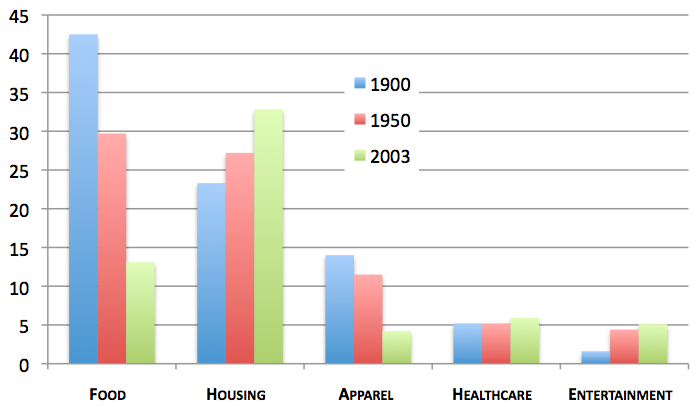
A significant decrease in food prices under a membership structure also brings about another interesting topic: the percentage of household income that was spent on food over 100 years ago versus now.  Take a look at the chart all the way below.

In 1900 the average percentage of household income spent on food was significantly higher than it is today. Back then food cost more simply because there were many more local farms (6-7 million farms for a population of 75 million compared to around 1 million farms for a population of 330 million today) that did not have the production efficiencies and low labor costs of the large industrial farms today. With the industrialization and consolidation of the food industry and widespread urbanization in the later half of the 20th century food prices went down considerably. The same sort of thing happened with clothing. Entertainment, eating out, healthcare, automobiles, travel, and especially housing and higher education make up the bulk of household spending today to meet the demands and pleasures of a modern lifestyle. 

A marketing firm that I'm working with, Milk Street Marketing (cool people-check them out if you need help with your business), asked me when we first met who my competitors are. I gave them a long winded, highly ideological, disconnected-from-reality, newsletter-esc spiel (amazing that they still took me on as a client) about how my competitors are not places like Whole Foods, Giant, and Acme. They are rather places like movie theaters, restaurants, travel agencies and airlines, universities, and hospitals and healthcare providers (this was all kind of a joke of course but not really?) Pretty much anything that gets in the way of increasing the percentage of household spending of food back to 1900 levels.

Well, for those for whom this food is less financially assessable, theaters etc are not by my choice but by default indeed competitors if I maintain the current business structure of buying local foods and marking them up by some percentage. Just to use the logical fallacy of appealing to extremes for fun, this would in its extreme form involve trying to unravel a hundred years of economic growth, urbanization, and modern convivences so that everyone just spends most of their income on food (or supplies to grow food) and not much else. Of course that's ridiculous. Fun to think about in a Little House on the Prairie sort of way, but lets not go down that route (unless you wanna?) If however the business structure changes to something like Costco's model, well, then, looks like places like Whole Foods, Acme, and Giant could actually be real competitors since the prices would be pretty close. 

I want local, organic food to be affordable to all. It's a challenge that could take a long time to figure out. Politicians are not talking about it in any feasible way. We gotta do it ourselves. I hope to have a better answer in 2023.

Germany

I just got back home from my trip to Deutschland. I'm doing my best to stay up till 10 so that the jetlag doesn't ruin my sleep schedule. When I arrived in Germany I asked my friends to keep me up. Despite my protests, they successfully did so. Now I'm hoping that writing this email will keep me up. 

I had a great time! Saw old friends. Walked around Christmas markets. Explored the old fairytale towns of Idstadt and Rüdesheim. And drank some Riesling by the the Rheine river in the Rheingau wine region.

The special bread this Thursday and Saturday by the way is the German style Schwartzbrot. This is pure coincidence. I ate some while there. The one from Ursa Bakery is better. Tut mir Leid, aber tut mir Leid nicht, Deutschland. ("Sorry but not sorry, Germany")

Throughout Germany commemorative plaques called Stolpersteine (literally stumble stones) eternalize the lives of those lost during the Holocaust. They are laid into streets and sidewalks in front of the last known addresses of victims before their deportation and eventual murder. It is always chilling to stumble across these stones while walking to a bus station or going for an after dinner walk. Despite how much I've studied the history of this region, how a crime of such magnitude occurred will never cease to perplex and horrify me.

I visited Germany in 2006. It was a spur of the moment decision to go. They were doing quite well in the World Cup, which was actually taking place in Germany at the time. After they they played a remarkable game in the quarter final, I realized that this may be the only time in my life when I could see Germany win the World Cup in Germany. I booked a flight immediately after they won the quarter final. Annnd they promptly lost the semi-final a couple days after. I still had a great time. Germany won the 3rd place match while I was there. And I celebrated with all the Italians around town after Italy won the final against France. It was all somewhat disappointing for Germany, but the excitement that soccer brought out in people made the atmosphere lively, fun, and exciting. 

The stark contrast between the 2006 trip and this trip reconfirmed for me that Germany has since the Holocaust become a bastion of human rights. Every single person I interacted with was protesting the World Cup, which is going on now. Not a single bar or restaurant had it televised. This is because Qatar, the country hosting the World Cup this year, imprisons anyone engaged in same-sex sexual activity. And if it is a Muslim, they face execution under Sharia law. While Germans have been the most outspoken against the Qatari government today, all of this is complicated by the fact that the German government just decided to buy gas from Qatar for the next 15 years as a way to reduce dependency on Russian gas. All very messy.

While the atrocities of the 20th century--the Armenian Genocide, the Holodomor, the Holocaust, Cambodia, Darfur, etc etc etc --are all in the history books (well, some history books), evil acts are not confined to history and they are not confined to distant places. They are widespread, under our very noses, twisted within the wild realm of geopolitics/international trade, and are often closer to home than is readily apparent. Even many of the foods stored in our kitchen pantries are produced via them.

Pictured below are stones down the street from my friend's house in Wiesbaden.

On the left reads:

"Here lived Henrietta Leoni. Born 1870. Deported to Theresienstadt (this was a waystation to the extermination camps and also a "retirement settlement" for the elderly in German occupied Czechoslovakia) 1942. Died in Feb 21st. 1943."

On the right reads:

"Here lived Heinrich Leoni. Born 1908. Deported to Lublin (a ghetto in Poland) 1942. Murdered August 4th 1942 in Majdanek (a concentration camp adjacent to Lublin)."

Ice Cream

Over the course of the last several weeks I had the arduous and painstaking task of sampling dozens of ice cream flavors from all of the ice cream makers in our locale. Fortunately I emerged from these trials unscathed and with a new product to hit the shelves next week.

The thing about ice cream is that most creameries purchase an "ice cream base" from a large-scale industrial operation. These bases are composed of dehydrated milk powder (coming from bad dairy farms), all sorts of preservatives, chemicals, and artificial sweeteners. They then mix this base with their own flavorings. There are not very many creameries that make their own base (it requires a hard to get USDA certification), let alone very many creameries that use local, seasonal fruit and pastured dairy. There are a couple in our area that fit the bill, but one stood out: Owowcow Creamery. After experiencing the hospitality that I was shown there, learning about their philosophy, and tasting all of the flavors, I realized that this was the ice cream that I wanted to offer. They source their milk and cream directly from Painterland Farm, a local organic dairy farm owned and run by two sisters. The cows graze on open pasture. Most of the other ingredients are local. And those that are not, like the vanilla and chocolate, are coming from good sources. The decision was pretty easy, honestly, and I'm grateful for a friend who recommended them to me.

Anyway I'll be carrying 10 flavors in pints and 2 of their ice cream pops. I'm not getting them this week. They'll arrive next week. But I was just too excited to wait till then to tell you. They'll only be available at Huntingdon Valley. Elkins Park folks: it's worth the drive. I do hope that the self sacrifices that I made to fill my belly with copious amounts of ice cream over the course of the past couple weeks prove to be worthy.

How to put on socks

It’s interesting to me how each farm that I’ve worked at has a different feel. There are farms where the pace of work is quite relaxed. Work often slows down or even stops when a farmhand tells a joke or an interesting story. These farms are probably closest to how I romanticized farming before I ever started doing it. Oh how that all crumbled upon my first days at some of the more intense farms. Speed and efficiency are paramount. I had to learn how to work quickly and socialize at the same time.

Farming is tedious. Farmhands do the same movement over and over again for hours. A normal day could comprise of harvesting and bunching kale from 7:00 till 12:00, an hour lunch break, and planting tomatoes from 1:00-6:00. What can at first glance appear to be a small inefficiency doing these tasks can over those several hours result in a serious setback for the entire operation. The crew must then work later to accomplish everything. It leads to burnout.

A good farmer will teach his or her farmhands how to work as efficiently as possible with each seemingly insignificant hand movement. I am fortunate to have had mentors who railed this into my head. I recall something that a fellow farmhand jokingly said to me once.

Man, I’m even getting more efficient at putting my socks on!

I’m finding that I need to reapply these principles now that there are two locations. This past week was – well – very difficult and taxing. It also didn’t help that the walk-in freezer at Creekside broke down (again)…had to move a half ton of meat to the chest freezers that I always have on standby for when this happens.

I’ve been trying to figure out how to most efficiently order for two stores and one farmer’s market. Vegetables are the most difficult item to figure out since they are the most perishable. I won’t bore you with the specifics. Just take my word that there is a lot to juggle. The vegetable quality/quantity at the Elkins Park location suffered last week because of all this. I apologize. It’ll get better as I relearn how to put on my socks.

As a first step I’ll be working back at Creekside on Fridays and Brigette will be working at Huntingdon Valley starting this week. At the second location I'm very much enjoying seeing people who used to come to my backyard years ago when I was farming in Huntingdon Valley. And I'm very much enjoying getting to know new people. Your excitement and words of encouragement mean the world to me. I'm grateful. I'm also missing faces at Elkins Park at the same time.

People often ask me if I miss farming. It's a difficult question to answer. I think that the main thing that I miss about farming is the fellowship that I had with people while doing the tedious tasks that I mentioned above. There is something about doing such tasks alongside others that naturally gives rise to good conversation and light-hearted fun. When I started my own farm it was just me doing tedious tasks alone. It wasn't the same. In fact it was rather lonely. So it's not farming I miss as much as it is people. I think that my presence at both locations would lend itself to having comradery with as many of you as I can.

Meat or Plants?

This week let’s explore various diets within the context of agriculture alone. I am not going to make any health claims about a meat-based or plant-based diet. I’m no expert on nutrition. Experts always make opposite claims about cholesterol and saturated fat. Unfortunately they generally do not take into account how different forms of agriculture relate to human health. They treat both animal-based foods and plant-based foods homogeneously.

In today’s newsletter I’m going to argue that, first, it is not a great idea to treat human health independently from the nuances of agriculture. Diet and human health no matter what we each choose to eat is tied to the environment. In the long run they come back to effect politics, economics, and human health. Second, it is misleading to claim that a plant-based diet is what's best for the environment. There’s a lot to consider.

I first want to discuss something that’s happening right now in the Netherlands. Tens of thousands of Dutch farmers are protesting, blocking roadways, intimidating governmental officials, and blocking supermarket distribution hubs across the country in response to legislation that requires them to cut emissions of nitrogen oxide and ammonium by 50% by 2030.

The Netherlands is the largest meat exporter in the EU; 60% of its agricultural revenue comes from exports. It isn’t exactly one of the largest countries by land mass, either. So this means that their more than 100 million chickens, pigs, and cows are packed tightly in feedlots. Runoff from the animals’ waste goes into waterways (the Netherlands has got a lot of those), creating dead zones that negatively impact protected habitats, air quality, and water quality. After Dutch courts decided to halt construction and infrastructure projects due to fears that those projects would lead to excessive emissions, the legislature decided to take action on farmers knowing full well that “not all farmers will be able to continue their business.” The Netherland’s ambitious climate goals has had some far reaching implications.

While the pollution caused by industrial agriculture is noticeable and pronounced in the Netherlands since it’s a small, densely populated country, we have similar problems here. Please take a look at this map, which shows how much landmass is used for various purposes.


That huge block front and center for cow pasture looks alarming. So much land for animals that create so much pollution? The obvious solution is to eat less meat and dairy, right?

It’s not that simple. I’d like to divert your attention to the bottom right of that large block, to the smaller blocks labeled “livestock feed” and “feed exports” (and also “ethanol” and “corn syrup”). These smaller blocks are the problem and I believe that the “cow pasture” block could even be even larger.
 
Most beef cattle spend the first 10-14 months on that large block eating grass. Meanwhile on the “livestock feed” block conventional farmers grow GMO corn and soy. They put some bad synthetic fertilizer into the soil and they spray some bad chemicals on the plants and they purchase all that bad stuff from some bad companies. They till the soil twice a year, which is also bad. The harvested and processed corn and soy eventually meets those now older cattle in feedlots to be “finished” for the last 3-4 months before slaughter. Adding to the damage done by growing and processing the corn/soy, the feedlots result in waste runoff as I mentioned above. That’s the deal with beef cattle. Conventional dairy cattle never see pasture and never eat grass. This is because conventional dairy farmers would have to bring in the cows from pasture to milking barns twice a day. Not possible when you have an enormous herd.

Even though those 3-4 months are a small fraction of the bulls’ total lives, the finishing stage does immense environmental damage. It’s also psychologically and physically damaging to them. They can’t even properly digest grains so they immediately get sick and are thus pumped full of drugs.

Contrast this to 100% grass-fed cattle. The cows have plenty of space, are under the sun, and eat what their complex digestive systems and gut flora allow them to eat. Since they aren’t crowded in feedlots and since they don’t depend on high impact corn/soy, there are no detrimental environmental effects. In fact, it’s a net positive. The dung and urine that goes into the soil enhances a pasture’s microbial life, which sequesters carbon and traps it into the soil. A recent study showed that a 100% grass-fed operation has a carbon footprint 111% lower than conventional beef: that means that for every kilogram of beef produced, 3.5 kilograms of carbon is sequestered. That’s taking into account every aspect of the farm’s operations.

Now let’s compare ruminants (beef, bison, venison, elk, sheep, and goat) to poultry and pork. Chickens, turkeys, and pigs do not eat grass. They are still dependent on corn/soy feed. The chickens I get meat and eggs from are pastured, so there is the benefit of carbon sequestration, and they do eat bugs and worms as they naturally should. The pigs I get pork from are rotationally grazed in the woods, so there is also carbon sequestration and they eat plenty of tubers and nuts as they naturally should. But the diet of bugs, worms, tubers, and nuts is more of a bonus. The animals are still highly dependent on corn (less dependent on soy: the farmers use a feed that is low in soy): non-GMO corn and soy, but corn and soy nonetheless. That comes with the negative impacts of tillage and fertilizer. But this is A LOT better than feedlot poultry/pork that uses GMO corn/soy.

Next step: let’s compare and contrast livestock farming with produce farming. With produce farming we need to distinguish between annual foods (plants that live 1 year: most veggies) and perennial foods (plants that live longer: most fruit). For a deeper discussion of annual vs perennial agriculture, click on the link.

First annuals: vegetable growers generally till every year in order to incorporate fertilizer into the soil and also to get the ground into a workable state to allow for planting. Tillage is not a great thing. I discussed this in previous newsletters in depth so I won’t go into it, but just take my word for it for now. But the fertilizer used by organic vegetable farmers comes from factory farms with animals that eat corn/soy: feather meal, blood meal, bone char, liquid fish from fish farms, etc. There is a method of farming called “veganic” farming that uses leaf compost. In fact when I farmed I did so veganically. But this was only possible because I had access to Abington Township’s amazing leaf compost yard. Normally compost is not an ample source of nutrients. However if you add A LOT as I did it can be sufficient. But veganic farming is very rare. Most organic farmers use byproducts of feedlots (Biodyanmic farms are an exception too-too much to get into now). We can either choose organic produce with feedlot byproducts or conventional produce with synthetic fertilizers (also problematic) and sprays. Pick your poison. Veganic no-till or Biodynamic no-till are the crème de la crème for annual produce production. It requires municipalities to pick up leaves and compost them with sufficient aeration. Abington is incredible at this.

Now perennials: pretty simple here. Fruit trees do not require tillage and do not require fertilization. They’re pretty easy going. They are the ruminants of the plant kingdom. But the downside is the spray. It takes a lot to be an organic orchardist in this region. There aren’t many, and those who grow stone fruit and apples organically do not do so at any volume to wholesale. The fruit I offer is IPM (Integrated Pest Management) which means that the trees are monitored and sprayed only when necessary. I have also heard rumors that the organic fruit in grocery stores is coming from organic trees that are surrounded by conventional trees, creating a barrier. I haven’t been able to confirm this.

There are many things that I didn’t mention. The point that I’m trying to make is that the “eat less meat” argument from an environmental standpoint is somewhat simplistic. On the contrary out of each of the agricultural categories that I’ve discussed the only one that is without fault is grass-fed ruminants. Not only is it without fault but it’s the only category that’s a net positive for the environment when raised the right way. There are no external inputs needed: poultry and pork need externally grown corn/soy, annual produce needs tillage and externally produced fertilizer, and perennial produce needs sprays. Grass-fed ruminant farming is the least impactful form of agriculture today.

While a ruminant-based diet is the least impactful, I'm not advocating that we all eat nothing but rib eye and cheese. I'm only pointing out that any argument for or against a diet requires consideration of  different agricultural methods. Also, it seems to me that those who pose solutions to the climate crisis are doing so solely within a "do less harm" (less emissions) frame of mind rather than a "do more good" (carbon sequestration) frame of mind. So in the Netherlands legislators give more emphasis to "doing less harm" via reducing herds within the existing feedlot system rather than "doing more good" via assisting farmers to transition to a pasture-based system. I think that we need a combination of both of these mindsets because most forms of agricultural are inherently destructive. This will always be the case in a modern world where most people are not growing their own food. Unless we start growing food in test tubes (over my dead body, Bill Gates). For those forms of agriculture that are inherently destructive (pretty much most of them besides raising ruminants), I think we should focus on less harm: less tillage, less sprays, less animal-based fertilizer, less corn/soy reliance. And at the same time I think we should focus more on those forms of agriculture that are "doing more good:" pastured ruminants, oyster farming (they filter water), mushrooms (which break down organic matter into stable carbon), veganic no-till, and Biodynamics (Biodynamics is Pandora's box and I'm not opening it today).

It’s a messy situation in the Netherlands. Many farmers want to transition to a pastured system but need more time and financial assistance to pay off debts. Other farmers don’t want to change. Legislators say it’s time to make a difference no matter what even if it means many farmers go out of business. What got the Netherlands into this mess to begin with was their conscious decision to feed the world. They accomplished it temporarily but sacrificed a lot. A global food system that pushes the boundaries of what the environment can sustain does not work in the long run. It never will. Many Dutch farmers are worried that the entire industry will collapse. It might. I hope that the rest of the world learns from their mistake.

Dave and the Chocolate Factory

Yesterday I visited the Moka Origins factory in the Poconos where they make their wonderful chocolate. Over the past year I've started offering some products that don't grow anywhere around us: spices, chocolate, coffee, etc (actually I think that's it?) I was always hesitant to carry these because generally speaking the further one gets away from the source of one's food, the more likely it becomes to overlook the ills of an ethically broken system: forced child labor, unfair pay, lack of reinvestment, low grade ingredients, to name a few. Some large multinational, publicly traded food companies have a tendency of caving into Corporate Social Responsibility (CSR) after mounting pressure from activists, retailers, customers, and politicians, but I have always found these efforts to be insincere and inadequate. I had a job in a past life where I worked for a socially conscious investment firm. A part of my job was to interview the CSR departments of publicly traded companies to see if their efforts were good enough for us to purchase shares. I never really thought that they were.

I checked out Moka's website after one of my customers/friends told me about them. After a phone call conversation, it became clear to me that environmental stewardship and positive social impact is their raison d'etre. While many large companies have CSR departments as a side thing, Jeff, the founder and CEO, started Moka in order to do things like paying farmers a living wage, reinvesting in local infrastructure, combating poverty, and helping the environment. It's why these chocolate bars cost $8.

For a while I've been wanting to address inflation on this newsletter, something we are constantly hearing and thinking about these days. Seems like the right time to do it now. There are exceptions, but for the most part I am finding that inflation mostly effects goods and services that are closely tied to global markets and long distribution chains. To borrow Thomas Aquinas's idea of primary and secondary causation, I'd argue that monetary policy, fiscal policy, geopolitical conflicts, and pandemics, everything that we hear in the news that all too easily invites blame and outrage towards one or another political party, are all secondary causes that are not as significant as we are told. The primary cause of high levels of inflation, I think, is more likely the fact that the global economy is made up of long, complex web of producers and distributors. The components of a glass jar and lid, for instance, circumvents the globe several times before it hits a shelf somewhere. A rise in price of just one resource, like oil, compounds down the supply chain.

But this doesn't really happen in a local economy. It also doesn't happen with companies like Moka, which deals directly with farmers abroad instead of with distributors who deal with distributors who deal with distributors who deal with an auction house which deals with a distributor who finally deals with a farmer. Fewer degrees of separation mean fewer compounding price hikes. So despite the fact that we have over 8% inflation nationwide, only eggs have gone up in price here at Dave's Backyard Farms (by 50 cents).

The thing is, a globalized system that has large companies acting within a complex distribution web brings with it efficiencies and economies of scale that allow for ARTIFICIALLY LOW prices. The very reason why these prices are artificially low subjects them to inflationary pressure. In the chocolate and spice industries, these low prices in turn are detrimental to farmers in Africa and Latin America. Contrast this to Moka: the price of $8 a bar is NORMAL; normal because it allows for a normal living wage; it allows for normal infrastructure investment; and it allows for normal environmental stewardship. The interpersonal relations and emotional exchange that occurs between farmers and Moka employees on a regular basis are absent in large, multinational companies. All too easy for business practices to consciously or unconsciously result in exploitation when that's the case.

This type of sourcing is not only beneficial to people and the planet, but it also results in greater economic stability. When we hear about inflation in the news, I try to think less about the secondary, more fleeting causes that we hear about all the time. The primary cause is deeper, more hidden, and is connected to other problems.

Anyhow, I had a great time there. Moka's factory is located on the beautiful Himalayan Institute, where I stayed for a night. It's a yoga retreat with really nice hiking trails. I haven't done much yoga, but I did some while there. And some silent meditation. It was a nice way to take a rejuvenating mini-vacation. I'm back now with a bit of caffeine withdrawal, full of chocolate and schnozberries, and I look forward to seeing your smiling faces this week.

How to help Ukraine

I want to talk a little about how the scars of century-year old national tragedies reopen during modern-day acts of aggression. Ukraine has for over a hundred years fought for her autonomy, and the most devastating event in her history was the Holodomor (literally "death by starvation") that occurred under Joseph Stalin in 1931-1933.

In his First Five Year Plan Stalin's goal was to rapidly industrialize the Soviet Union to catch up with the West. A part of this plan was to integrate privately owned land into collectively-owned, state-controlled farms called kolkhozes (collectivization), to requester grain to support urban factory workers, and to deport/murder those who Stalin and his cronies considered to be "wealthy" peasants. They were called "kulaks," and the deportation/murder of them was called dekulakization-close to 2 million people. The grain quotas placed upon the remaining farmers were unrealistic and the resulting removal of grain from the countryside let to the mass starvation of millions. Ukraine was hit the hardest, since Ukraine was the breadbasket of the Soviet Union and of Imperial Russia before it. Around 5 million Ukrainians died of starvation.

This is the official position of the Russian Federation and of some bad historians. While it's partially accurate, it's not even close to a complete description of the Holodomor. This description makes it seem as if the death of millions was the result of the Soviet Union's economic policies taking precedence over individual human life. Certainly it was to some extent a result of this, but it is also the result of Stalin's intentional strategy of crushing Ukrainian national aspirations, of consolidating his power, and of ushering in the socialist revolution. The famine was closely tied to the murder of Ukrainian nationalists, who just a couple decades prior had achieved a short lived independence. Correctly labeling the Holodomor has been a point of conjecture amongst governments and historians, and lots of this has to do with the limitations of the UN's definition of "genocide" (guess why it's so limited--Stalin petitioned the UN in the 1948 to limit it) but there is no question that the events that took place in 1931-33 Ukraine constitute genocide.

We see a lot of the same rhetoric in Russian state media involving the invasion of Ukraine today as we did in Soviet publications in 1931. Just as Putin calls Ukrainians "fascists and neo-Nazis" to justify his war, Stalin called Ukrainians "fascists and bourgeois nationalists" in 1933. Just as Putin is suppressing journalists today who tell the truth, Stalin suppressed knowledge of the famine within the wider Soviet Union and prevented outside journalists from coming in. Just as Putin is opposed to schools teaching Ukrainian and not Russian, Stalin engaged in a linguistic Russification campaign in the late 1920s. It's a lot of the same thing.

In September 2020 when Azerbaijan invaded Nargono-Karabakh, majority occupied by Armenians for millennia, we feared that once they took the territory there would be an ethnic cleansing. That's exactly what's happening in the region: ancient churches and cemeteries have been destroyed and ethnic Armenians are being murdered and forced out of their homes. It reopened the historic scars of the genocide Armenians experienced in 1915. I believe that the Ukrainians are experiencing something similar. We both have genocides in our history that are not widely recognized and we are both the subject of aggression by tyrants. In fact I originally started studying history because of the Armenian Genocide. I later realized that there are other genocides in history that aren't widely recognized, which ultimately led me to writing my undergraduate thesis on the Holodomor and Ukrainian history. What's going on today hits home.

There are many ways to help Ukraine. Here are some links to donate :
Razom: https://razomforukraine.org/donate/
Ukrainian National Women's League https://unwla.org/top-news/call-for-humanitarian-aid/
United Help Ukraine: https://unitedhelpukraine.org/donate

The Ukrainian Educational and Cultural Center at 700 N Cedar Rd is accepting donations of non perishables Mon-Fri 9am-7pm which they ship over to Ukraine. Check out their website to see what they are in need of.

Please support Ukraine in any way that you can, and please keep them in your prays.